


Stitching Up Old Wounds: Artist Maral is Threading the Past Into the Future
Interview by Taleen Posian
This interview has been edited for length and clarity
Noor: How would you describe your artistic practice as a whole?
Maral: The first word that comes to mind is multi-disciplinary and inspired by tradition. It wasn’t always like that, but for the past five years, I would say my main source of inspiration is my culture. Before that, I was more universal, but now I really pull from my culture because I realized there’s so much to preserve and so much that I don’t know yet.
Noor: Embroidery, as we know, has played a long-standing role in Armenian culture, spanning from religious art to everyday objects. Was that something that drew you to the craft of embroidery? What role do you see embroidery playing in contemporary art and culture?
Maral: Absolutely. When I said that I draw from my tradition, I think we can both agree that for women, embroidery has been an empowering tool for creation, and I believe that women are creators. It’s very important for us to keep our culture alive through these art forms. When you embroider, the act of it is very calming and peaceful, and you really have to be present in the moment. So I would say that’s the number one thing that drew me to it because it’s more about the process than the outcome. You have to make sure that everything is meticulously done to the correct detail. To feel the needle through the fabric, for me, that’s the most beautiful sensation. That puncturing is very healing. I can’t explain it. I see my own heart as like this wound that I sew with needle and thread, and I feel like our people have a lot of wounds to heal, and embroidery is one way to stitch our past into our future. That was so poetic!
Noor: I’d love to know if you have a specific piece that comes to mind when you discuss these poetic ideas of ‘your heart is being stitched up’ and ‘you’re stitching up wounds.’ Are there any pieces that you have done that you’re thinking of specifically?
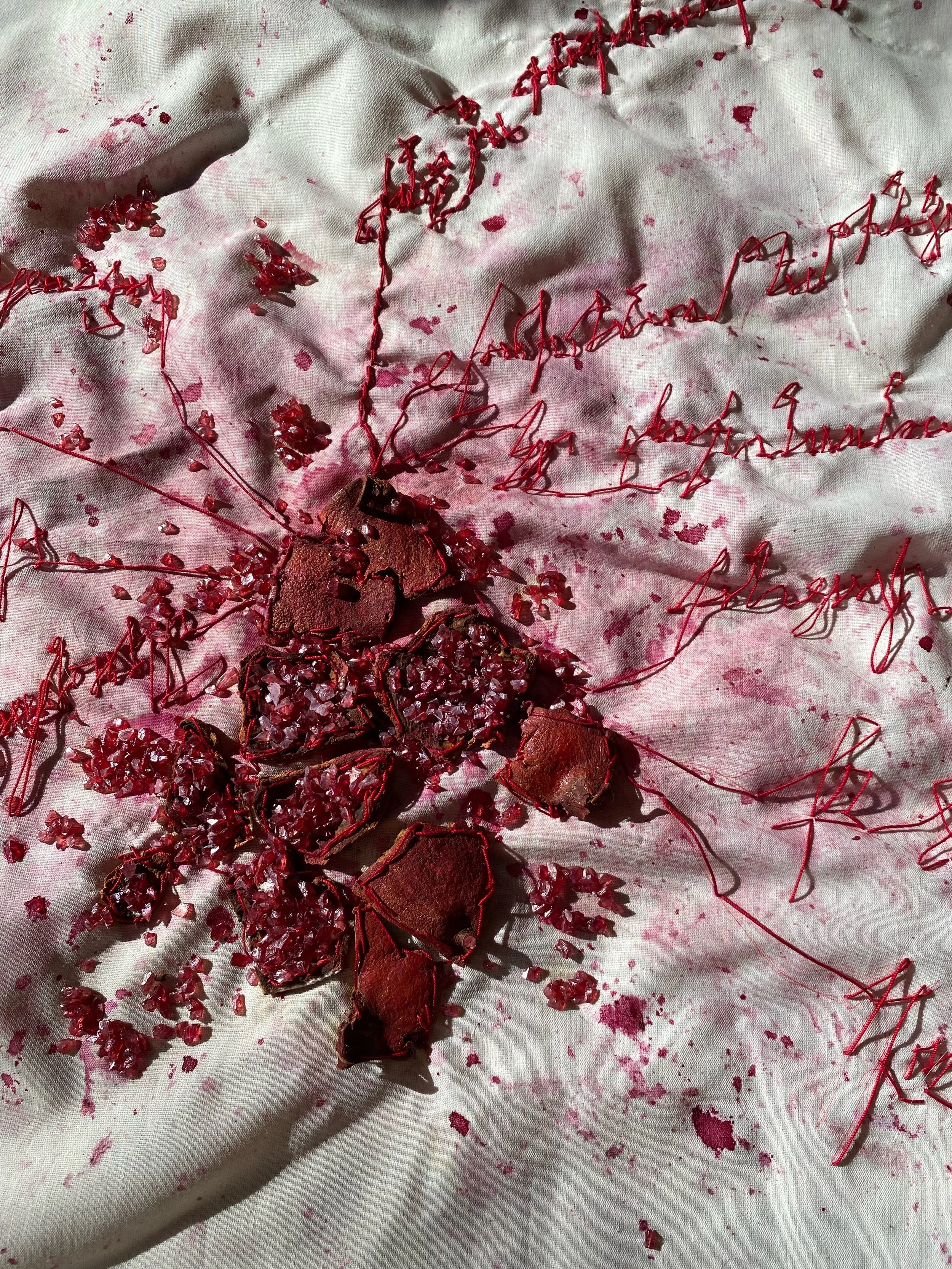
Maral: Yes, it’s a piece I did for my final in university, and it’s called Bloodlines. I began it with a white sheet from my grandmother, whose grandparents and parents actually fled the genocide, so for me, that white sheet is like ‘whoa’. I took the white sheet, and I was bleeding. So I was like, ‘I don’t know how to start this piece. I don’t know how to do this project.’ And I just let the blood be the first point in the center. From there, I took a dried pomegranate. Sewed the pomegranate on that blood. And then with a red thread, with no plan at all, I embroidered in Armenian script what I would say to my ancestors if they were still alive, if they hadn’t died from the genocide. And all of this pressure and expectations that I was putting on myself and wishes for my people. It was the most emotional thing I’ve ever done.
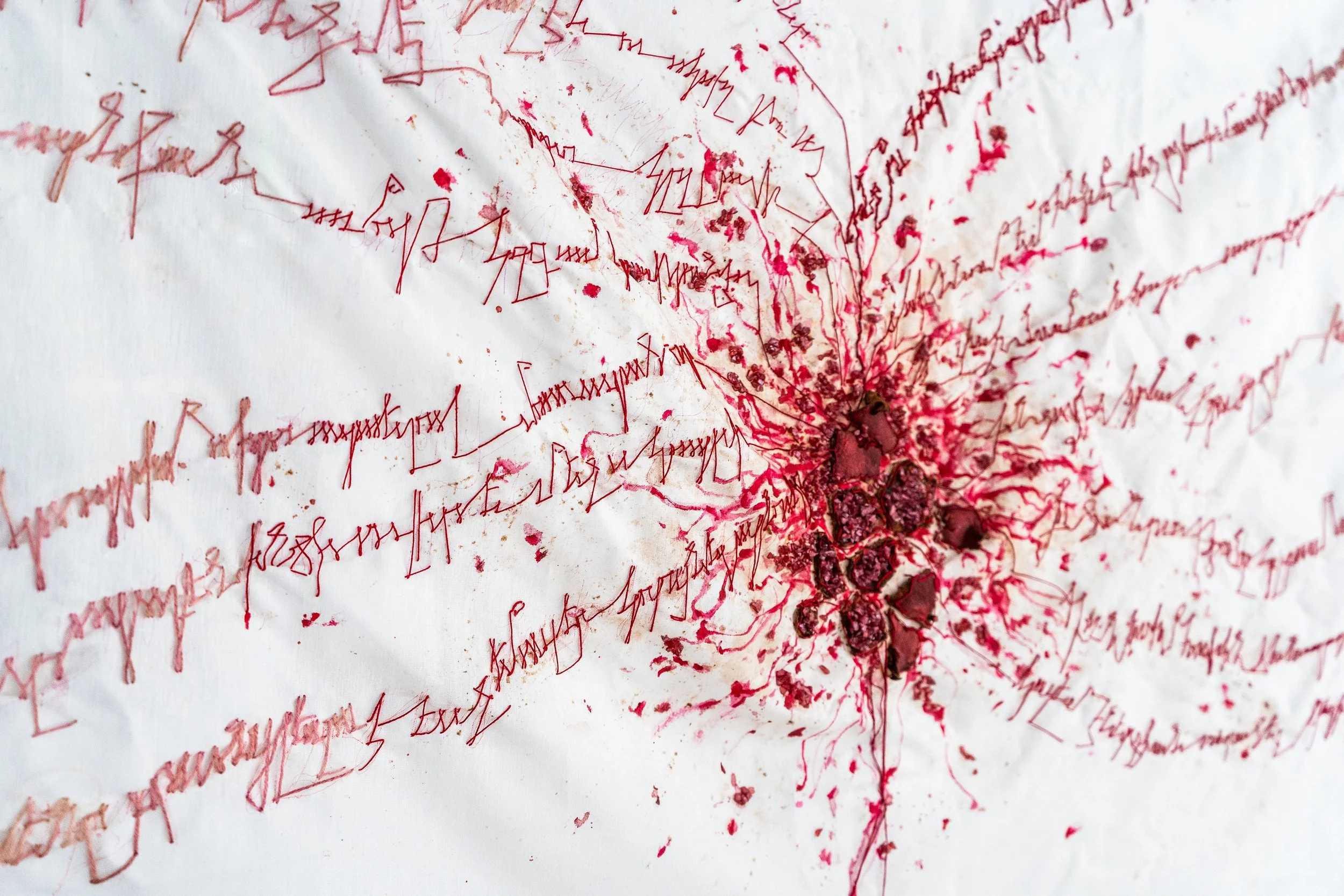
Noor: It sounds like it. I love the different physical mediums that you were able to use, the idea of dried fruit, as well as blood, as well as thread, as well as a historically important garment. I would love to hear you discuss any other sort of disciplines that you find yourself working within.
Maral: Can I say dance and body? ‘Cause I believe that’s a form of art as well. And in Armenian tradition, there’s like so much there that I would like to learn. And also watercolor. Watercolor, gouache, dance. I have not yet sung, but I’m thinking maybe I should start singing, I don’t know. Because, to be completely honest, I used to be very ashamed of dancing and my body. I used to think I would never, I could never be a dancer like, what would I do? But then I, during COVID, I just, I don’t know, I lost it. I started dancing every day and now I’m so comfortable. I’m the first one to dance if there’s a dance.
Noor: That’s great to hear your growth, adopting a new medium, this far into your artistic practice as well. Besides singing, are there any other artistic venues that you’re looking towards?
Maral: I would say big canvases and murals, because like there’s so much space to fill. When I was in Yerevan, not long ago, we went to the Aivazovsky painting exhibition. And he had this one Ararat painting that was huge. The exhibition person asked us, ‘How long do you think this took him?’ And we were like, oh, three months, five months. [it was] One day, one day! And I was like, I’m too [much of] a perfectionist! So I would like to be able to complete larger pieces in a shorter amount of time. To just let everything out and be like, it’s done. Sometimes it’s hard to know when to finish a piece.
Noor: In the interdisciplinary space, what I’ve seen in some of your works, you often present your embroidery alongside poetry. As you were saying before, you weave in words, like you weave in a letter to your family. Tell me about your process of creation there. Do your ideas come to you in words first or visuals first? How do you want your viewers to read the work? Do you want them to read it sometimes or take it in as a complete visual? Tell me about the process and creation there.
Maral: Well, to tie back to the example of the Bloodlines work, nothing was planned. I was just like ‘I don’t care.’ It was just gonna come from my heart and soul and I don’t care what people think. So it was very careless. That sounds very harsh and blunt and mean, but it’s, for me, it’s authenticity. Authenticity matters the most. So as much as I try to curate a poem or curate words, if it doesn’t feel true, I don’t see the point in putting it out into the world. But for example, if there are known Armenian prayers, I will embroider those. This Jerusalem prayer, that is a prayer that already exists. And that, I feel, is authentic because it’s part of history. Convening emotions through words and actually conveying a message through words in Armenian is something I’m trying to get better at because I want to improve my Armenian and I think it’s very important to preserve our language in our script. But to be completely honest, when I make my pieces, I’m not sitting there and like writing everything out and editing everything. I try as much as possible to just do it.
Maral Matig, “Bloodlines,” 2023
Photo by @bellescx on Instagram
Maral Matig, “Bloodlines,” 2023
Noor: I love that you didn’t say, ‘Oh the visual comes first or the poetry comes first,’ it’s not either/or. That’s really interesting
Maral: Yeah, yeah, they’re tied. They’re interwoven
Noor: Tying it back to Noor’s theme of evolution and traditions, turning into innovation. I would love to hear more about your philosophy of weaving in tradition with the current, with your future work. One thing that I love in your work is Marash embroidery. You put ancient visual Marash patterns onto modern t-shirts and skirts. I would love to hear more about those works in particular.
Maral: So I see a new wave happening with our generation, and on one hand, I see people criticizing it, saying, ‘You should never mix modernism with tradition.’ And on the other hand, there are people who are very open-minded who are like, go ahead, ‘this is what our ancestors would want.’ I’m going to do it because I just think that culture is always changing and if we stay stuck in one place, we will never grow and move forward. So I personally have a lot of hope in the new generation of Armenians because I see that they’re both open-minded and also very passionate and willing to preserve their culture because they see how important it is to be Armenian. Me, when I was younger, I had a lot of shame around being Armenian. It took me a while through art and music to really undo that. But I see now I’m meeting younger Armenians than me. They’re just like, ‘Oh yeah, I love being Armenian.’ They want to learn embroidery and stuff. And I’m like, ‘Wow, I’m really glad that there’s a positive thing around this.’ Yeah, I have a lot of hope. But I know your question was more about my art. The funny thing is, I don’t see my art as separate from our community. I personally don’t like viewing myself as “I’m Maral, the artist.” I view myself as part of this web of all these in other Armenian artists that honestly have inspired me since the beginning. It’s them who brought me here to where I am today. I think we’re all working together. So, where do I see my art going? I see it connecting with more Armenian artists and creating more tight-knit web connections. I think together we are much stronger than individually. And in the West, it’s very easy to fall into individualism, but I think our culture is very rooted in the collective. I think we should think about that more.
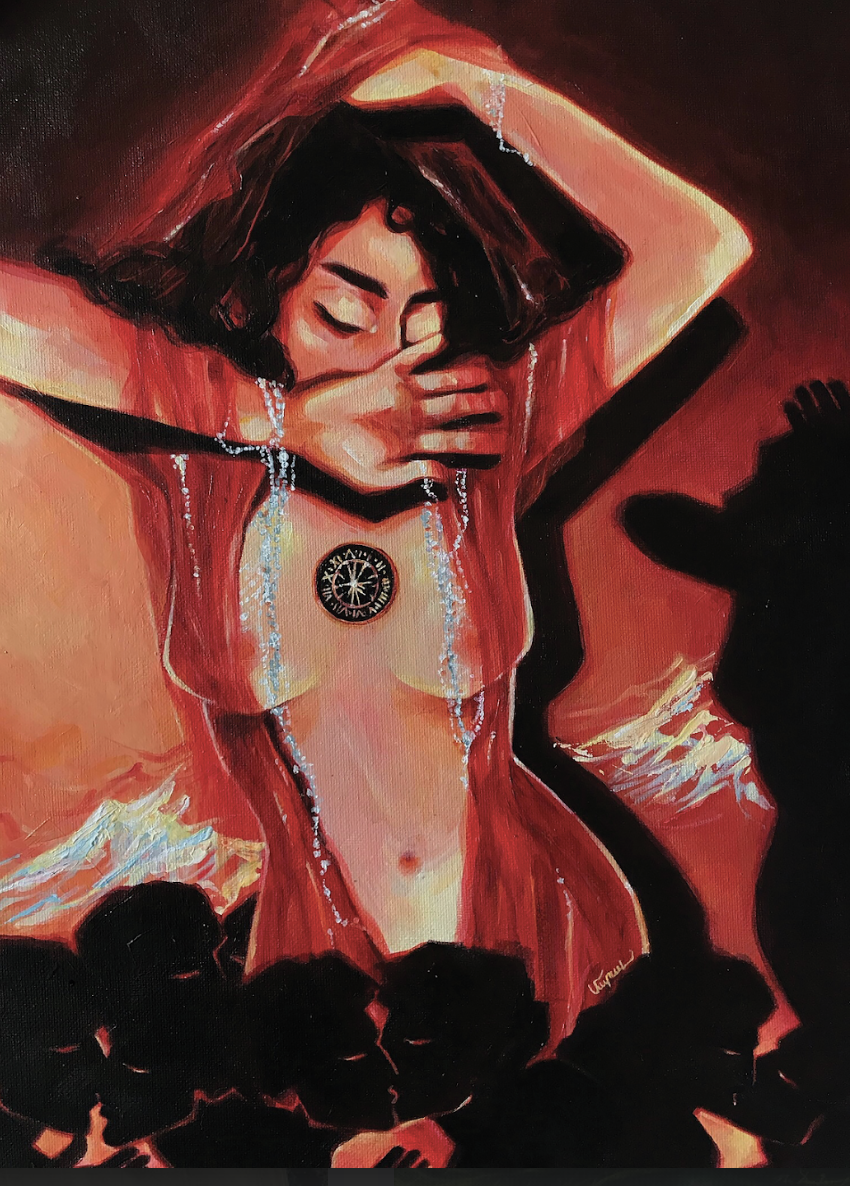
Maral Matig, “Shadows,” 2020
Noor: Do you have any works that you’ve done in particular that you think touch on these themes of connection?
Maral: That’s a very good question. Right now, I can’t think of one, but I would say any of my works that involve dance, especially when there are figures like doing yarkushta, just like shourchbar. That to me is the number one symbol for connection because when you understand the history of the circle, the shourchbar, you must all be holding hands; otherwise, if there’s an open gap, negative energy comes in. And I think that’s just such a beautiful concept.
Maral Matig, “Armenian Comic Strip,” 2021
Noor: In another theme of connection and culture, I’ve seen some of your art includes explicit interwoven Armenian and Palestinian visual motifs. I would love to hear more about your work that includes those.
Maral: This is very heavy for me, but I’m gonna get straight into the vulnerability of it. Right after the Artsakh genocide, it was the Gaza genocide. I cannot not see a parallel between the two; I cannot be blindsided and only focus on one. Because I believe in humanity above all. There are just too many parallels between both of our communities and cultures. And at that time, I think like most of us, and still right now, I was in a lot of pain. But art became a way for me to heal, as it always has been. But to really see similarities with another group of people brought me hope. I don’t know how to explain it, but as I was embroidering, especially [the piece I just showed you], I felt like I was regaining some strength to be like, you know what, I can preserve two cultures at once. I can be Armenian and still care about another culture. I think sometimes we’re too much like only Armenian, which is good, right? It’s good. But, we kind of have to see like, okay, you know, genocide is not just… it happens to many different communities. How can we be in solidarity together? And I would say my Palestinian Armenian pieces received the most positive feedback from all of my other pieces because of that solidarity. Like people recognize that, okay, there’s empathy here. I’m not just thinking about my people. Empathy for me is also very crucial.
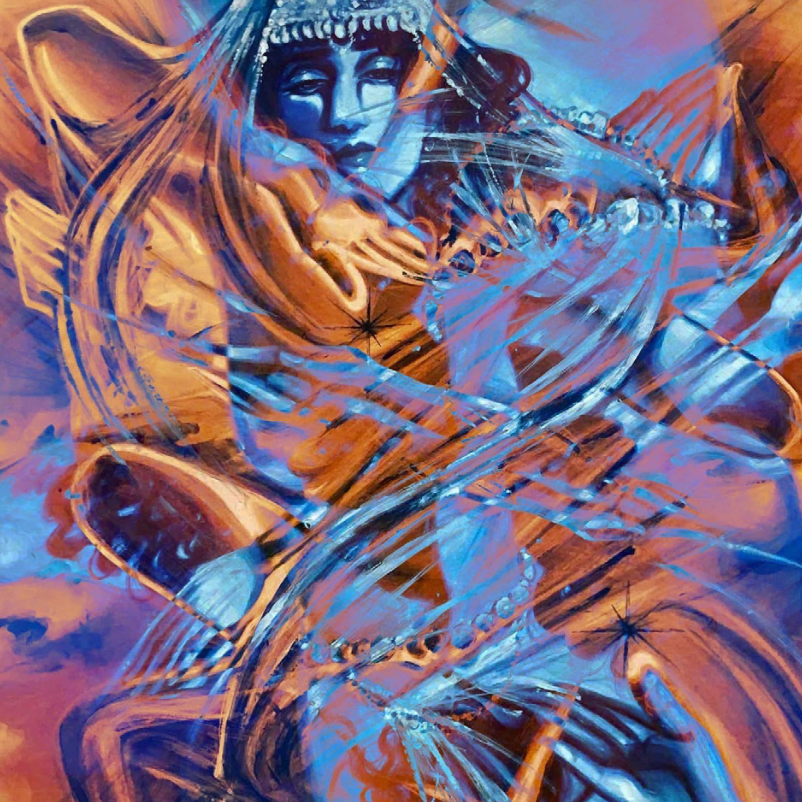
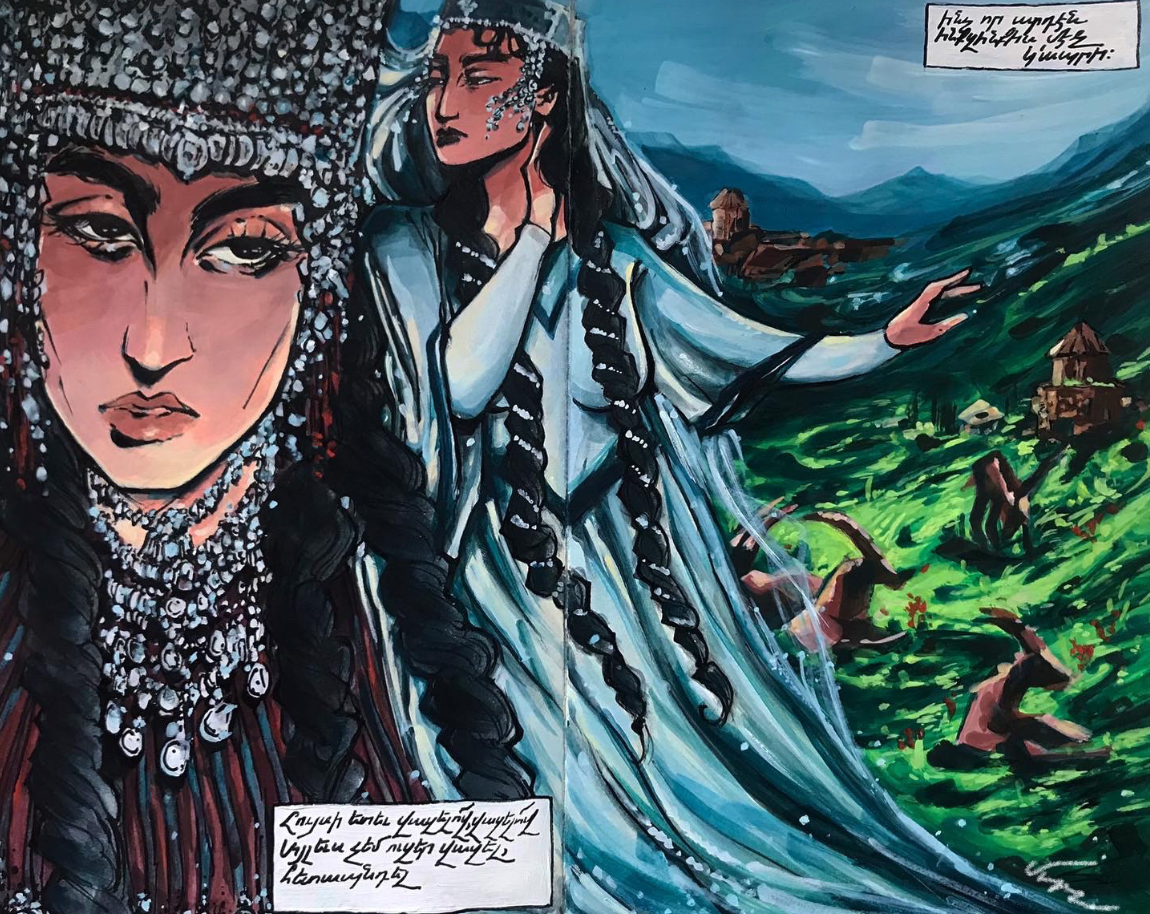
Maral Matig, “Mountain Girl,” 2022
Noor: That was really beautiful. One thing relating back to Noor, as both a visual art and a literary magazine, the idea of blending these mediums really interests me. And you said that one of your favorite artists is Darvish Sevruguin, who you noted in one of your posts communicates the spiritual and poetic nature of the Armenian language through his brushstrokes. As someone who incorporates script and typography in your visual art, what are your thoughts on the blend of language and writing within something that’s traditionally image-based?
Maral: I think, him as an artist, he was very ahead of his time. When I first saw his work in Yerevan, I was like, ‘this exists?’ This is literally what speaks to my soul. When I was talking before about blending the contemporary with tradition, I think he does that so beautifully and effortlessly. When you look at the Armenian script, it’s very angular, but also fluid. And I think when you look at that and then you incorporate imagery and color into it, it’s like a dream. But your question was the importance of blending the textual with the image. I think it comes down to communication. The more mediums you have to communicate an idea, the more it can reach different audiences, I believe, because you’re keeping the door open. You know, some people tap into the visuals. Some people tap more into the written. But when you blend both, it’s like you’re kind of broadening your audience and you’re meeting more people and you’re speaking to more people’s hearts, which I think is the purpose of art. It is to be able to speak directly to the human heart.
Noor: Well, that was beautiful. Thank you. Speaking also of the idea of the visuals of the Armenian language being angular. I love how you phrased that. One of my favorite types of Armenian art is trchnakir, and I know that you have discussed that before, in your research into manuscripts. Could you discuss your relationship with that specific type of Armenian design trchnakir, and if you have done any works within that medium?
Maral: Of course, I would say what draws me most to trchnakir is the spirituality of it. When you look at ancient illuminated manuscripts and gospels, the trchnakir is there, and I believe it's to signify this ascending and freedom. Because when you think of a bird, what is the meaning of a bird? You spread your wings and you give yourself to God. The intricacy, the detail, the gold around those letters, each single letter has a meaning. The amount of care that is put into that, I believe, speaks volumes for the craftsmanship and spirituality of the Armenian people. So when I saw those for the first time at the Matenadaran, the Museum of Manuscripts in Yerevan, I was just blown away. I was like, there's so much uncovered about our culture, but to see them in person is like, wow, and it just makes me want to preserve it more. I've been doing trchnakir work for, I don't know, how old am I, I'm 24, so I would say like seven, eight years. I recently started embroidering trchnakir, which is very difficult, but I completed my first shirt for a client and I'm very proud of it. I want to do more works like that. They're mostly gifts I do for people, like personalized gifts. I think it's a beautiful way to gift someone something that, you know, is close to their culture. For my school project, I did a digital medium. So I'm really interested in playing with the digital. I would, by hand, draw some trchnakir letters and then edit them in Photoshop, invert them. I think inversion is so fun and cool. I've done that, experimented with that, but a final big piece with trchnakir, I have not done yet. I would love to. Like, if you can imagine a whole poem, each letter in trchnakir, that would be awesome.
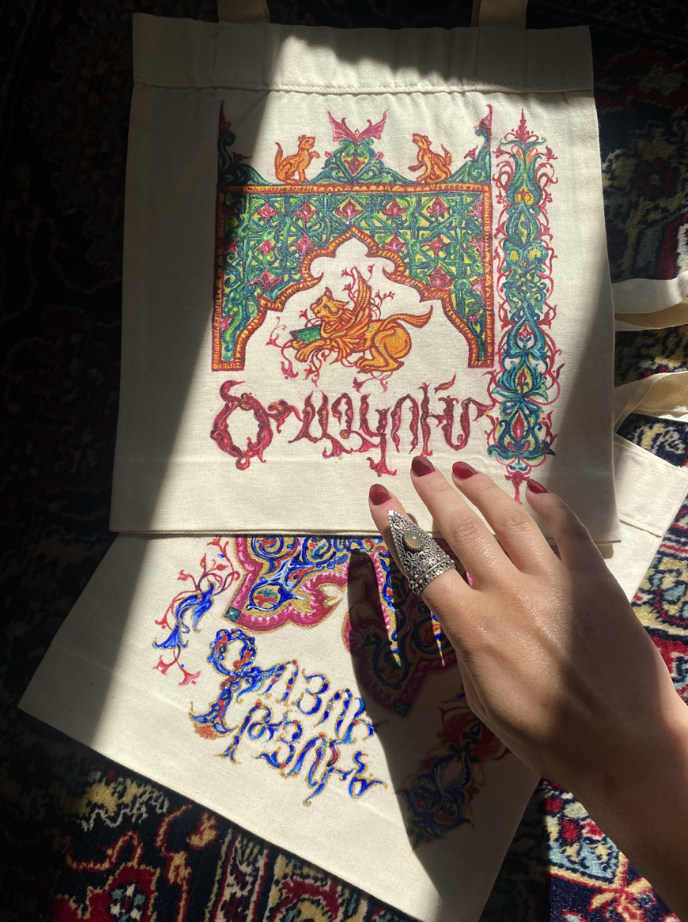
Maral Matig, “Manuscript Bags,” 2024
Noor: Besides incorporating dance more, doing bigger canvases, a whole poem… What else do you see within the near and the far future of your artistic practice? What are you working towards? What are you dreaming of?
Maral: I really want to get good at Marash embroidery, to a point where I can recreate old carpet designs. So I don't know if you've seen, like, especially Artsakh carpets, they are extremely intricate with colors and lines. I want to be able to create that on clothing or things that people can keep and that will last a long time, so that we can preserve those motifs. A lot of Armenian carpet patterns have very deep meaning, and I think it would be a shame for those to go to waste. So that's my next thing, really getting good at embroidery, but also watercolor. I want to preserve the emotions I feel when I'm in Armenia. The scenery of everything is just so comforting, and I've recently started a mixed media sketchbook, and I want to, from the fresh memory I have, recreate those churches with watercolor and line work. That's one of my favorite mediums. I would say watercolor or gouache with an intricate black pen. Other than that, like I said, big canvases, but I'm still scared. I have a canvas like right here, and I'm just looking at it, and I'm like, ‘I don't know what to do.’
Noor: Well, it sounds like some of your most poignant works are done with no planning. I feel like that might be how your first big canvas comes to be.
Maral: I agree with you.
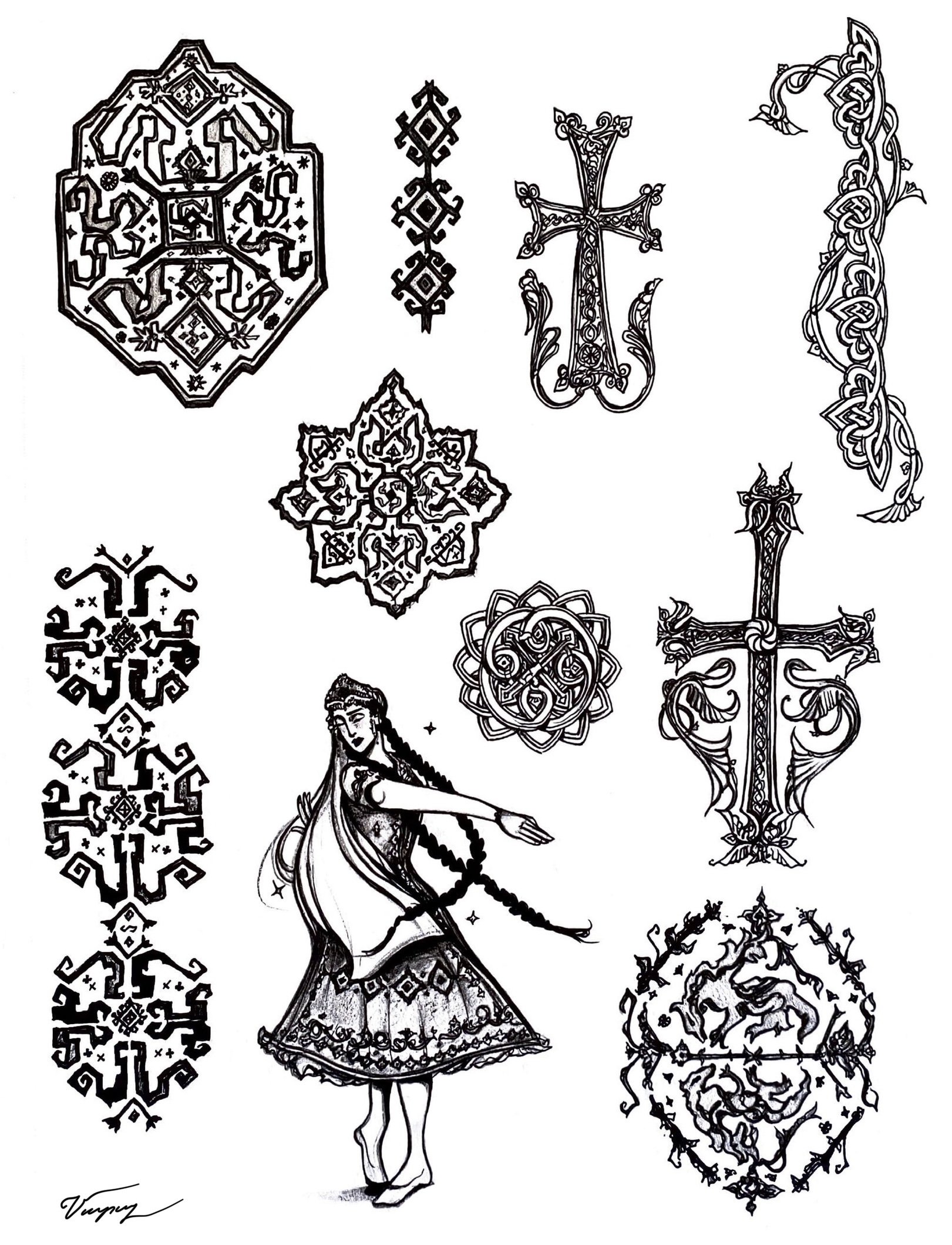
Maral Matig, “Artsakh Tattoo Flash,” 2023
Noor: Noor translates into both light in Arabic and pomegranate in Armenian. I would love to hear—and you kind of already touched on this a little bit—if you find that your art touches on either of those themes. Any sort of connection you feel with the meaning of Noor.
Maral: Absolutely, noor, for me, I think of it more as pomegranate, and fertility and life, but also blood. Not in a violent way, but also in a violent way, because we have lost a lot of blood in our bloodline. But blood is also life, and it is what ties us to each other. When I hear Armenian music, my blood literally boils, like you feel it. And I don't know what to call these, like visual hallucinations. I don't think they're hallucinations, but I'm definitely very creative up here [taps head]. And sometimes I will just visualize my blood, my veins, connected to Armenian soil. And I think about how our blood is still in that soil, from the genocide. And it's what ties us to the land, is that blood. And it's what ties us to each other. So, Noor for me is blood bound, but also life, fertility, those symbols of the pomegranate. And because I don't speak Arabic, but I'm also very interested in Arab culture, Noor is also the light, to shed light. I have to think more about that. I do want to add, I see it when I visualize the word Noor, I visualize it as an opening, like, you know, rays of light for the future, because I have hope for our futures.
Noor: I don't know if you took a look at our logo, but our logo for Noor is an ‘o’ with like spokes of light poking out, so you really were aligned right there.
Maral: I didn't think about that. It just came naturally, but that's good. That means that it works.
Noor: Oh yeah, definitely. Our creative director will be happy to hear that.
Maral: You like, subconsciously made me think about the meaning.
Noor: Thank you so much for your time today. I want to give you this spot at the end to basically talk about any part of your visual artistic practice that I haven't been able to ask you about that you would love to discuss.
Maral: I, for a long time, have wanted to be a tattoo artist. It was my dream to be a tattoo artist, and I'm seeing all of these Instagram pages and also people in Armenia with traditional Armenian tattoos that I'm just blown away by. I'm very inspired by those. They’re minimalist, they're intricate. I'm going to bring it back to the collective, the community, seeing people wear our culture on their skin, it says a lot. I have the “Arev Khatch” tattoo, the Sun Cross. This is the only tattoo I have, and it is the best decision I've made in my life. I'm going to tie it back to preserving symbols. There are very ancient symbols in our culture that we don't know the meanings of. And I think it's our job to dig really deep and use art as a way to discover more about our history and bring us closer together.
Noor: I could not have planned it better. You're gonna hear why. We actually are interviewing two artists for this issue. You're one of them, obviously. The other, I kid you not, is an Armenian tattoo artist. (laughs) Seeing the way that you both have like connective tissue between what you're talking about, what you're inspired by, it'll be fantastic.
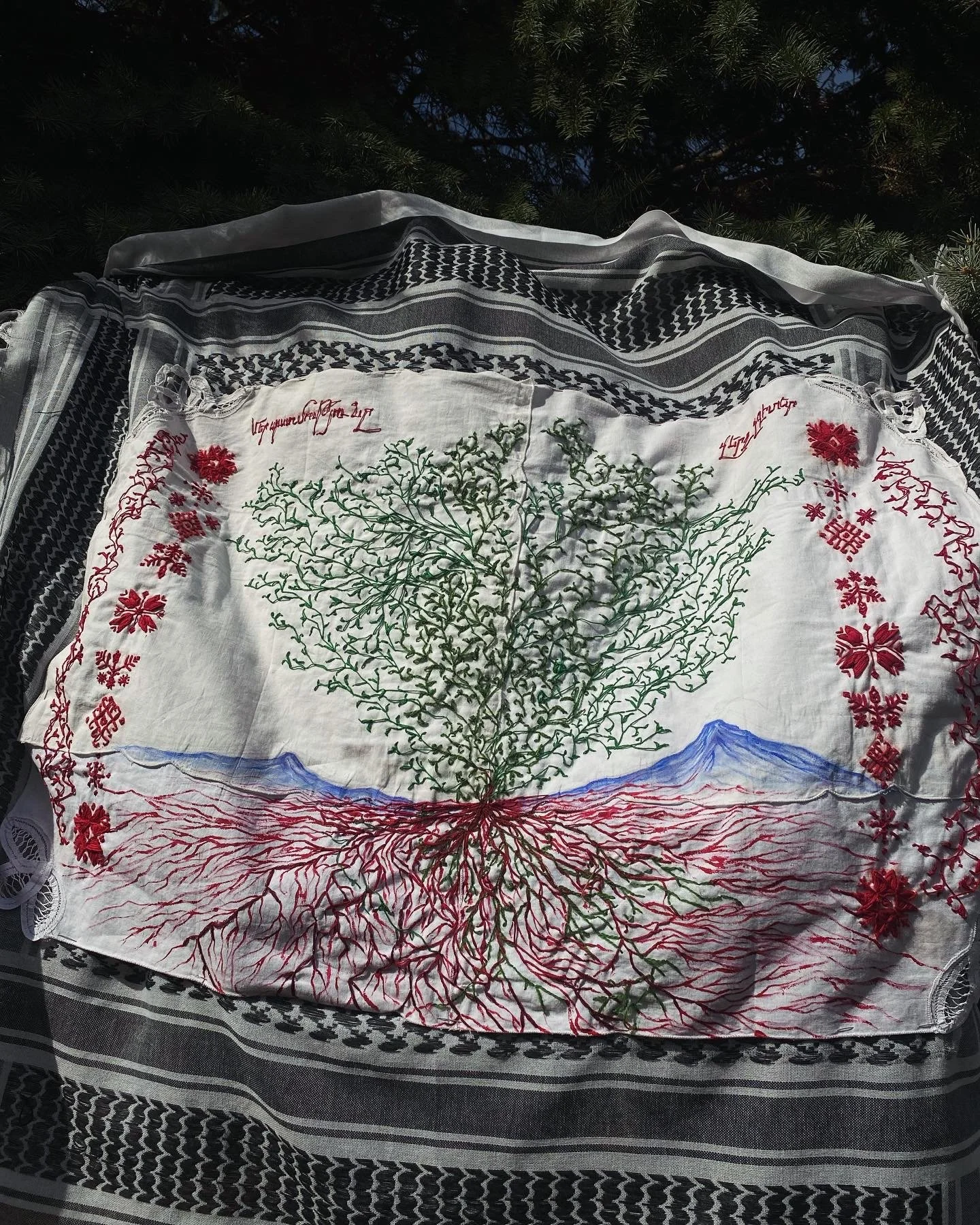
Maral Matig, “Zeytoun,” 2024
If you are interested in seeing more of Maral’s work, see here: @yerazimaral